Embedded systems · Feedback control
OccuSense
A prototype that uses force feedback to control strap tension, with a worm-gear drive and an interrupt-driven release.
- Role
- Project Manager & Hardware Integration Lead
- Timeframe
- Spring 2026
- Status
- Finished
What I built
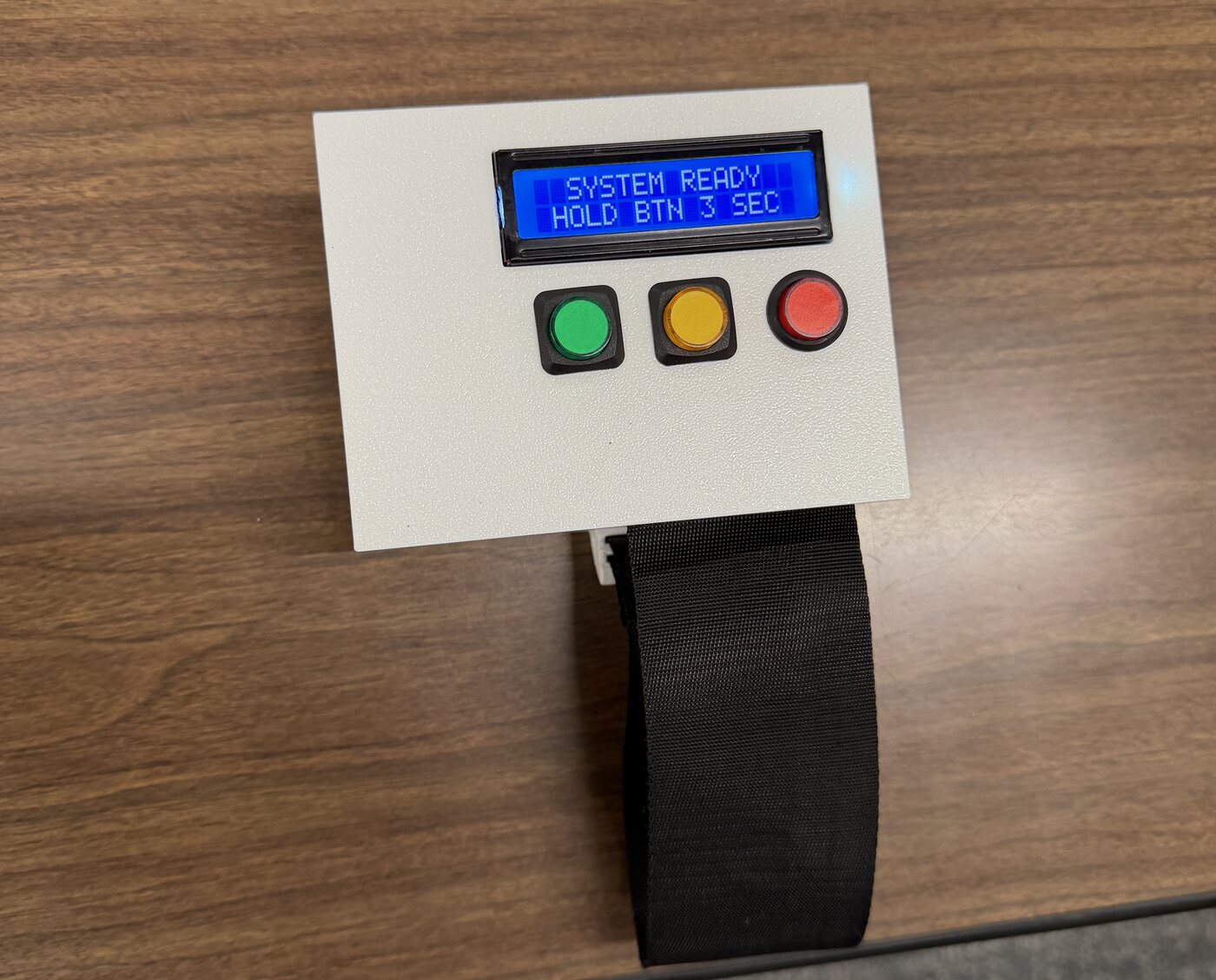
OccuSense was an automated tourniquet prototype for ECE 1022 Foundations in Design at Mississippi State University. It placed first in the Spring 2026 Electrical Engineering Design Competition, which involved more than 300 students.
My contribution
I managed subsystem responsibilities, deadlines, and integration. I led hardware integration, bringing the electronics, illuminated buttons, and sensors into the enclosure. I also supported the strap feed and motor and torque-sensing work.
Circuit and actuation
An FSR-402 and a 10 kΩ pull-down formed a voltage divider read on A0 of an Arduino Uno R3. An I²C LCD on A4 (SDA) and A5 (SCL) displayed the selected target and system status. The illuminated button LEDs used 220 Ω series resistors. The Uno, sensor, display, indicators, and TB6612FNG motor driver shared a common ground. The driver powered a reversible worm-gear mechanism selected to hold strap tension mechanically without continuous motor current.
Control and release
Holding the green or orange button for three seconds starts tightening. The controller stops the motor when the A0 reading reaches the selected ADC threshold and displays PRESSURE REACHED. The green target is 500 counts, labeled 120 mmHg on the LCD. The orange target is 1000 counts, labeled 170 mmHg. These are prototype target labels. The red button uses the D2 hardware interrupt to command three seconds of motor reversal to loosen the strap. The LCD then displays RELEASED. After three minutes of inactivity, the firmware turns off the indicator LEDs and LCD backlight and disables the motor driver.
How I tested it
Testing began in Tinkercad with simulated pushbuttons, external LEDs, and Serial Monitor output to check thresholds and state transitions. Breadboard checks covered sensor response, motor actuation, and LCD output. The final circuit was soldered onto perfboard and integrated into the housing. Testing was limited to simulation and bench work, with no human testing.
Firmware on GitHub
The Arduino Uno firmware used on the OccuSense prototype handled force-sensor feedback, motor control, front-panel inputs, LCD status messages, and timed strap release.
Engineering takeaway
Testing in stages helped isolate the firmware checks from the hardware checks. Simulation exercised state transitions, while the breadboard checked whether the sensor, motor driver, and display worked together before soldering.